Technology
Whole Cell Biosensors
Whole Cell Biosensors (WCBs) offers a unique advantage as the cell itself has the capability to sense a multitude of various types of small components including inorganic ions, proteins, hormones, antibodies, antigens, and other small molecules. The use of living cells as sensor elements provides high sensitivity to a wide range of biochemicals. Cells are equipped with highly specific and exquisitely sensitive recognition receptors and are smallest self-sustaining biological entity. In comparison with conventional detection methods such as nucleic acid or antibody-based assays,
WBCs offer the potential to detect both known and unknown biomolecules because their physiological effects are not specific for certain compounds. Other advantages of nonspecific biosensors are that they can be used to measure mixed toxicants and also can detect unpredictable additive effects between chemicals in complex mixtures and in environmental samples. WCBs provide rapid and inexpensive analyses, can yield high throughput and sensitivity, need small sample size, and are easily convertible to portable biosensors. In some WCBs, changes in gene expression pattern are key indicators of abnormalities. WCBs in which gene expression is monitored normally use electrochemical or optical tools for monitoring of pollutants.
Bioluminescence Technology
Bioluminescent bacteria are recombinant cells which emit light as a byproduct of their metabolism. Light changes can be used as indicator of toxicity. It has been shown that using recombinant bioluminescent bacteria for toxicity monitoring leads to better sensitivity, continuous monitoring, short detection time and visible optic responses. In this type of biosensors, the signal intensity is related to the level of the cellular metabolism. Bacteria species such as Vibrio fischeri, Salmonella typhimurium, Escherichia coli, fungi species such as Armillaria mellea, Mycena citricolor and some other species have been used as bioreporter of toxicity in WCBs.
ENVITOX
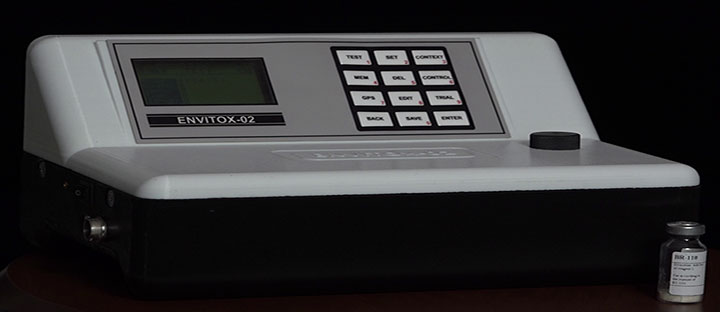
During last several years, our team has engineered a strain of Escherichia coli, BR-110, with bioluminescent properties. The BR-110 bioreporter is responsive a waste array of toxic material including organics, inorganics and xenobiotics. ENVITOX-02 which is second generation device produces and is optimized in both bioreporter and electrical parts. This device is portable and provides rapid quantitative measurement of integral toxicity of samples of water and aqueous extracts, alcohols, air, soil, complex materials such as polymers.